

Learn how to balance recruitment automation with human judgment to...
Read MoreCandidate Experience & Recruitment
Why Enterprises Need AI Recruitment Platforms
Enterprise hiring involves high application volumes, multiple business units, distributed decision-makers and complex workflows. Learn how AI recruitment platforms help organisations screen candidates faster, standardise routine processes and improve visibility—without removing human judgement from hiring.
By HireOne.ai Team
September 2026 • 18 min read
SCALE HIRING
Manage more applications and roles
REDUCE DELAYS
Automate repetitive recruitment work
IMPROVE VISIBILITY
Track candidates and pending actions
Table of Contents
Enterprise Recruitment Is Becoming More Complex
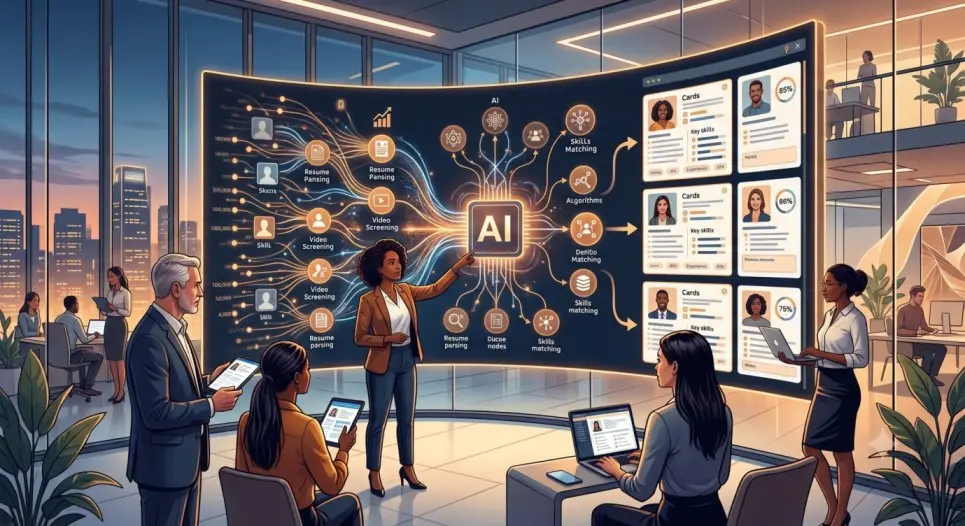
Enterprise hiring is no longer simply about filling open positions. Large organisations must manage thousands of applications, multiple departments, different hiring teams and candidates across locations—all while maintaining speed, consistency, fairness and oversight.
Traditional recruitment methods often struggle at this scale. Recruiters spend significant time reviewing resumes, coordinating interviews, following up with stakeholders, updating records and repeating initial screening tasks.
AI recruitment platforms provide a connected way to support candidate matching, resume screening, initial phone screening, interview coordination, workflow automation and recruitment analytics.
The goal is not to remove recruiters from hiring. It is to reduce repetitive work and give them more time for conversations and decisions that require human judgement.
What Is an AI Recruitment Platform?
An AI recruitment platform is software that uses artificial intelligence and automation to support different stages of the hiring process. Unlike a basic applicant database, it can help teams analyse candidate information, prioritise actions and coordinate workflows.
|
Create and organise Generate job descriptions, collect applications and maintain candidate records. |
Screen and match Parse resumes, compare profiles with job requirements and rank applicants. |
|
Coordinate hiring Conduct structured initial screening and schedule interviews. |
Track and improve Manage pipelines, automate workflows and generate recruitment reports. |
HUMAN OVERSIGHT : AI recommendations should support—not replace—recruiter review and final decision-making.
Common Enterprise Recruitment Challenges
Enterprise recruitment combines high application volumes with different approval paths, evaluation criteria, interview structures and compliance requirements.
|
High Application Volumes |
Slow Candidate Shortlisting |
|
Repetitive Initial Screening |
Inconsistent Evaluation |
|
Fragmented Workflows |
Scheduling Delays |
|
Delayed Stakeholder Feedback |
Limited Recruitment Visibility |
Why Enterprises Need AI Recruitment Platforms
1. Review Candidates More Efficiently
AI-supported screening can extract relevant information, compare it with job requirements and organise applicants for recruiter review.
2. Identify Relevant Candidates Sooner
AI matching can examine broader relationships between skills, experience and role requirements instead of relying only on exact keywords.
3. Standardise Initial Screening
Approved questions and role-specific criteria help teams cover the same essential areas consistently.
4. Reduce Repetitive Recruitment Work
Automation can support resume parsing, applicant ranking, phone screening, scheduling, reminders and reporting.
5. Improve Recruitment Speed
Connected workflows can identify pending actions and reduce avoidable delays without removing necessary evaluation.
6. Manage High-Volume Hiring
Bulk importing, structured screening and pipeline visibility help teams manage larger applicant volumes.
7. Create a Connected Candidate Journey
Coordinated statuses, communication, scheduling and next steps reduce confusion for candidates.
8. Improve Collaboration
Recruiters, hiring managers, interviewers and HR leaders can work from a shared view of the process.
9. Support Data-Informed Decisions
Centralised data helps leaders examine stage delays, candidate sources, withdrawals and offer outcomes.
10. Build Reusable Talent Pipelines
Recruiters can rediscover previous candidates for relevant opportunities, subject to consent and retention policies.
11. Scale Recruitment Operations
Automation helps existing teams manage higher demand without multiplying disconnected tools.
12. Strengthen Recruitment Governance
Structured records support accountability across criteria, feedback, approvals, status changes and communication.
Traditional Recruitment vs AI-Supported Recruitment
|
Recruitment activity |
Traditional process |
AI-supported process |
|
Resume review |
Recruiters review resumes individually |
AI organises and prioritises profiles for review |
|
Candidate matching |
Manual keyword and experience checks |
AI compares candidate information with role requirements |
|
Initial screening |
Repetitive recruiter calls |
Structured AI-assisted screening with oversight |
|
Candidate tracking |
Spreadsheets, email or separate systems |
Centralised candidate pipeline |
|
Interview scheduling |
Manual calls and email coordination |
Automated availability and calendar coordination |
|
Stakeholder follow-up |
Individual reminders |
Workflow-based notifications |
|
Recruitment reporting |
Reports compiled manually |
Centralised operational reporting |
|
Talent rediscovery |
Previous applicants are difficult to locate |
Searchable, reusable talent pipelines |
|
Decision-making |
Human decisions with fragmented information |
Human decisions supported by organised insights |
KEY MESSAGE : AI does not eliminate the need for recruiters. It changes where recruiters spend their time.
Important AI Recruitment Platform Capabilities
|
AI Candidate Matching |
Resume Screening and Parsing |
|
Applicant Ranking |
AI Phone Screening |
|
Job Description Generation |
Candidate Pipeline Management |
|
Interview Scheduling |
Workflow Automation |
|
Recruitment Analytics |
|
Enterprise Challenges and AI-Supported Improvements
|
Enterprise challenge |
Operational impact |
AI-supported improvement |
|
High application volume |
Slow resume review |
Resume screening and prioritisation |
|
Irrelevant applications |
Recruiter time is consumed |
Candidate-to-role matching |
|
Repetitive screening |
Reduced recruiter capacity |
AI-assisted phone screening |
|
Inconsistent review |
Uneven candidate evaluation |
Structured criteria and workflows |
|
Scheduling delays |
Longer hiring timelines |
Automated interview coordination |
|
Scattered candidate data |
Limited visibility |
Centralised candidate management |
|
Delayed feedback |
Candidates remain waiting |
Reminders and pending-action tracking |
|
Limited reporting |
Leaders cannot identify bottlenecks |
Recruitment analytics |
|
Lost previous applicants |
Repeated sourcing effort |
Searchable talent pipelines |
|
Rapid hiring growth |
Recruitment teams become overloaded |
Scalable automation and bulk processing |
How AI Supports Recruiters Without Replacing Them
Recruitment involves circumstances that cannot be reduced to data fields or matching scores. Recruiters need to understand motivation, transferable skills, career changes, employment gaps, negotiation expectations, candidate concerns and unusual but relevant experience.
|
AI Is Effective For |
Recruiters Remain Essential For |
|
Organising application data |
Understanding candidate context |
|
Screening and matching at scale |
Conducting meaningful conversations |
|
Automating routine coordination |
Providing reasonable accommodations |
|
Highlighting pending actions |
Monitoring fairness and resolving conflicts |
|
Producing operational insights |
Negotiating offers and making final decisions |
SHORT ANSWER : The strongest enterprise recruitment model combines automation with accountable human judgement.
Responsible AI in Enterprise Recruitment
Human Oversight
Candidates should not be hired or rejected solely because of an AI-generated score.
Transparency
Candidates should receive appropriate information about how AI supports screening or assessment.
Job-Related Evaluation
Criteria should relate directly to the position and avoid unnecessary personal data.
Privacy and Data Protection
Define what is collected, why it is needed, who can access it and when it is deleted.
Bias Monitoring
Regularly review criteria, outcomes, workflows and user behaviour for potential unfairness.
Accessibility
Provide reasonable alternatives and a clear route to human assistance.
Auditability
Record the criteria used, recommendation generated, reviewer actions and final outcome.
How to Choose an AI Recruitment Platform
1. Define the Recruitment Problem
Identify whether screening, scheduling, data fragmentation, feedback or visibility is the main constraint.
2. Evaluate Role-Specific Matching
Confirm that matching adapts to different positions, departments and seniority levels.
3. Review the Screening Experience
Assess relevance, clarity, accessibility and routes to human assistance.
4. Assess Workflow Flexibility
Check support for different stages, approvals, locations, business units and employment types.
5. Check Integrations
Confirm compatibility with career sites, job boards, email, calendars, HR and onboarding systems.
6. Examine Security and Privacy
Review permissions, encryption, logs, retention, backup and incident-response practices.
7. Look for Explainable Recommendations
Recruiters need job-related reasons, not an unexplained score.
8. Evaluate Reporting
Confirm reporting by role, department, location, source, stage, outcome and time period.
9. Plan User Adoption
Define ownership, training, documentation, pilot testing and feedback collection.
10. Measure Outcomes
Compare operational and candidate-focused performance before and after implementation.
AI Recruitment Platform Evaluation Checklist
READINESS CHECKLIST
Before choosing a platform, enterprises should confirm whether it supports:
- AI candidate matching
- Resume parsing and screening
- Applicant ranking
- AI-assisted phone screening
- Custom screening questions
- Bulk resume import
- Candidate pipeline management
- Interview scheduling
- Workflow automation
- Hiring-manager collaboration
- Candidate communication
- Custom reports
- Activity and decision logs
- Role-based access
- Integration capabilities
- Data privacy controls
- Human review of recommendations
- Explainable candidate insights
- Configurable hiring stages
- Multi-client or multi-business-unit management
The importance of each capability depends on the organisation’s hiring model and recruitment priorities.
Measuring the Impact of an AI Recruitment Platform
|
Recruitment Efficiency |
Candidate Journey |
Hiring Outcomes |
MEASUREMENT NOTE : No single metric proves recruitment has improved. Review results according to role complexity, location, seniority, hiring volume and labour-market conditions.
Common Implementation Mistakes
- Automating an unclear recruitment process
- Treating AI rankings as final decisions
- Using the same criteria for every role
- Failing to review generated job descriptions
- Collecting unnecessary candidate data
- Sending inaccurate automated messages
- Hiding AI use from candidates
- Ignoring accessibility requirements
- Failing to monitor potentially unfair outcomes
- Purchasing software without an adoption plan
- Measuring only speed and cost
- Removing human contact from important stages
- Keeping candidate data longer than necessary
- Using AI without clear internal ownership
KEY INSIGHT : AI can increase the speed of a process, but it can also scale existing problems. Improve the underlying workflow while implementing the technology.
Inside HireOne.ai
How HireOne.ai Supports Enterprise Recruitment
HireOne.ai helps enterprises organise and accelerate recruitment through AI-supported screening, matching and workflow management. It is designed to help teams identify relevant candidates sooner, manage high application volumes and maintain clearer visibility across hiring stages.
|
AI Job Description Generator |
AI Screening Questions |
|
Resume-to-JD Matching |
Applicant Ranking |
|
AI Phone Screening |
Bulk Resume Import |
|
Candidate Management |
Interview Scheduling |
|
Workflow Automation |
Reports and Activity Logs |
PLATFORM PRINCIPLE HireOne.ai supports recruiter judgement rather than replacing it. Human oversight, candidate privacy and fair evaluation remain essential.
Frequently Asked Questions
What is an AI recruitment platform?
An AI recruitment platform uses artificial intelligence and automation to support candidate matching, resume screening, applicant ranking, initial phone screening, scheduling, workflow management and recruitment reporting.
Why do enterprises need AI recruitment platforms?
Enterprises often manage high application volumes, multiple roles, distributed hiring teams and complex approval processes. AI platforms can reduce repetitive work, improve prioritisation and provide better workflow visibility.
Can an AI recruitment platform replace recruiters?
No. AI supports repetitive and data-intensive tasks, but it cannot replace empathy, contextual judgement, negotiation, relationship-building or accountable decision-making.
How does AI improve candidate screening?
AI can extract resume information, compare profiles with job requirements, rank applicants using defined criteria and conduct structured initial screening. Recruiters should review every consequential recommendation.
Is AI recruitment suitable for high-volume hiring?
Yes. It can support bulk applications, organised screening, interview coordination and pipeline tracking while keeping people responsible for review and final decisions.
What should enterprises look for in a platform?
Evaluate matching, screening, workflow flexibility, integrations, analytics, security, privacy, explainability, accessibility, audit logs and human-review controls.
How can enterprises use AI recruitment responsibly?
Use job-related criteria, candidate transparency, privacy protection, human oversight, bias monitoring, accessibility, explainable recommendations and clear accountability.
How does HireOne.ai support enterprise recruitment?
HireOne.ai supports matching, resume screening, applicant ranking, AI phone screening, bulk importing, scheduling, automation, candidate management, skills extraction and reporting.
ENTERPRISE HIRING SHOULD NOT DEPEND ON DISCONNECTED TOOLS
Screen applicants, identify relevant candidates and organise every hiring stage with HireOne.ai.
- Screen resumes more efficiently
- Find relevant candidates sooner
- Automate repetitive recruitment activities
- Coordinate interviews and stakeholder actions
- Maintain visibility across hiring stages
- No credit card required.
Create a More Engaging Candidate Journey.
Identify relevant candidates, coordinate interviews, organize communication and maintain visibility across every hiring stage with HireOne.ai.
Related Blogs

How Automation Reduces Recruiter Stress
Discover how recruitment automation reduces recruiter stress by simplifying resume...
Read More
Why Recruiters Spend Too Much Time Screening Resumes
Learn why resume screening takes recruiters so long and how...
Read More
Why Enterprises Need AI Recruitment Platforms
Discover why enterprises need AI recruitment platforms to automate screening,...
Read More