

Learn how to balance recruitment automation with human judgment to...
Read MoreRESPONSIBLE AI RECRUITMENT
The Balance Between Automation and Human Hiring
Automation can make recruitment faster, more consistent and easier to manage. Human recruiters bring context, empathy and judgement. The strongest hiring process combines both without allowing technology to replace accountability.
By HireOne.ai Team
October 2026 • 18 min read
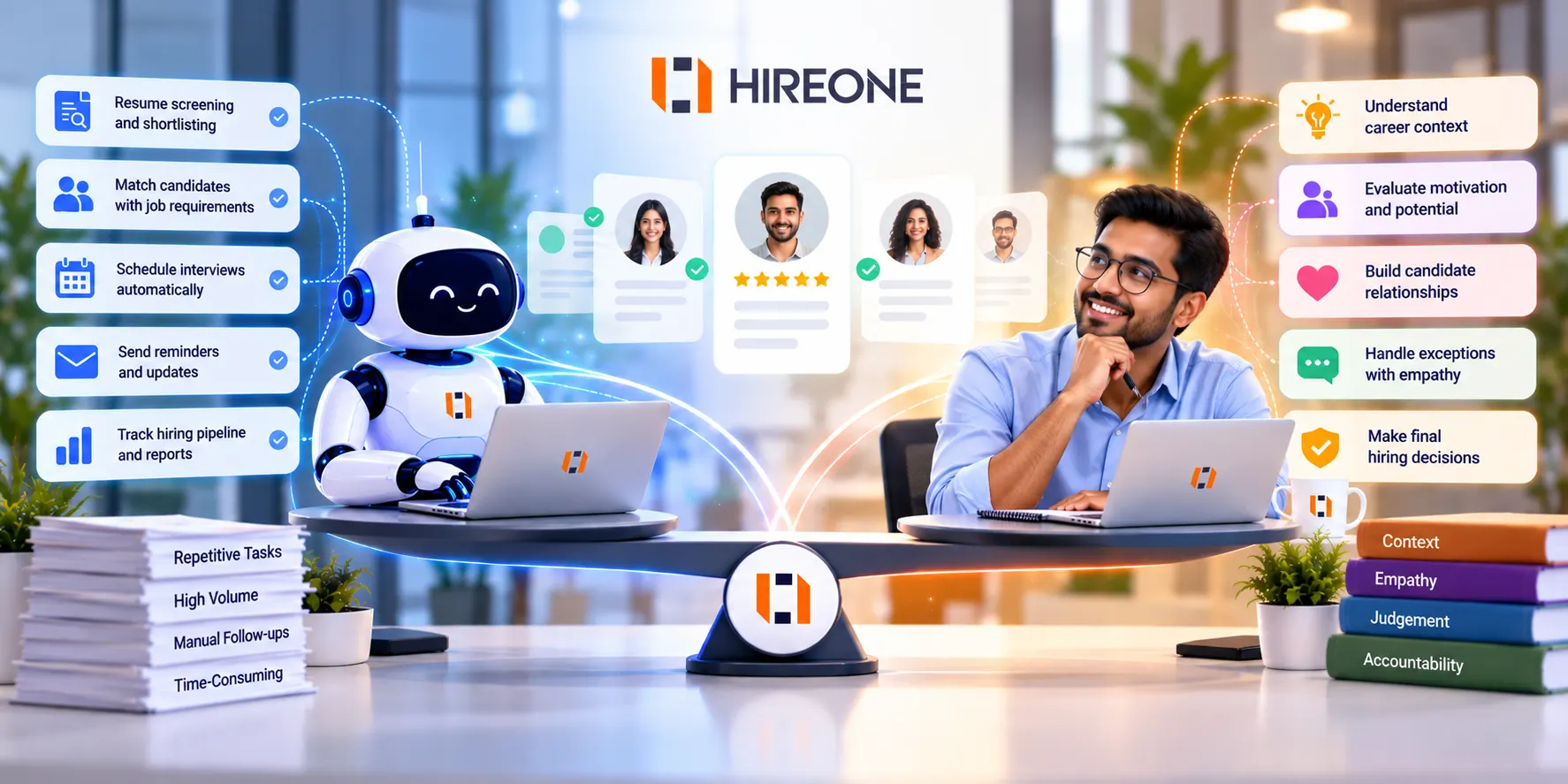
AUTOMATE REPEATABLE WORK
Reduce manual effort and delays
KEEP PEOPLE ACCOUNTABLE
Review context and exceptions
IMPROVE HIRING DECISIONS
Combine insight with judgement
Table of Contents
Better Hiring Is Not Human or Automated
The discussion around recruitment technology is often framed as a choice between automation and recruiters. In practice, the most effective hiring teams do not choose one over the other. They decide which work technology can perform reliably and which decisions require human understanding.
Automation is valuable when work is repetitive, high-volume, time-sensitive or dependent on consistent rules. Human involvement is essential when a decision depends on context, potential, motivation, fairness, trust or an unusual circumstance.
KEY INSIGHT: The goal is not maximum automation. The goal is a better hiring process with less repetitive work and stronger human decisions.
Why the Balance Matters
|
Speed Without Context |
Consistency Without Rigidity |
|
Efficiency Without Distance |
Data Without Assumptions |
|
Scale Without Losing Trust |
Insight Without Surrendering Control |
A balanced model protects the advantages of automation while preserving recruiter oversight, candidate dignity and organizational accountability.
What Recruitment Automation Does Well
Processing High Application Volumes
Resume parsing and structured data extraction reduce the time spent opening and recording individual profiles.
Matching Against Approved Requirements
AI can compare candidate information with job-related skills, experience and qualifications.
Repeating Structured Screening
Approved questions help teams collect comparable initial information from candidates.
Coordinating Interviews
Scheduling workflows can manage available slots, invitations, confirmations and reminders.
Maintaining Workflow Consistency
Automated stages and notifications reduce missed routine actions.
Organizing Candidate Information
A central record makes resumes, notes, screening information and status easier to find.
Supporting Timely Communication
Stage-based templates can provide acknowledgements, reminders and accurate routine updates.
Providing Operational Visibility
Reports can highlight application volume, bottlenecks, pending actions and pipeline movement.
What Human Recruiters Do Better
Understand Career Context
Recruiters can explore career changes, employment gaps, transferable skills and non-linear experience.
Evaluate Motivation
A conversation can reveal what a candidate wants, values and expects from the role.
Recognize Potential
People can identify learning ability and adjacent experience that may not match keywords exactly.
Build Trust
Candidates often need a real person to answer sensitive questions and explain uncertainty.
Handle Exceptions
Accessibility needs, unusual circumstances and complex role requirements require flexible judgement.
Assess Communication in Context
Recruiters can distinguish nervousness, cultural differences and communication style from capability.
Challenge the Hiring Brief
A recruiter can identify unrealistic requirements, inconsistent expectations or an unclear role.
Make Accountable Decisions
Final hiring decisions require ownership, explanation and responsibility.
Automation and Human Responsibility
|
Hiring activity |
Automation can support |
Human responsibility |
|
Job description |
Draft and structure role content |
Confirm accuracy, necessity and inclusive language |
|
Resume intake |
Parse and organize applications |
Review missing, unclear or unusual information |
|
Candidate matching |
Compare profiles with approved criteria |
Interpret context, potential and transferable skills |
|
Applicant ranking |
Prioritize profiles for attention |
Review recommendations and avoid automatic rejection |
|
Initial screening |
Ask consistent job-related questions |
Handle clarification, exceptions and candidate concerns |
|
Interview scheduling |
Coordinate slots and reminders |
Resolve conflicts and provide reasonable flexibility |
|
Candidate updates |
Send accurate routine messages |
Manage delays, sensitive news and individual questions |
|
Interview evaluation |
Organize scorecards and feedback |
Evaluate evidence and challenge unsupported opinions |
|
Offer process |
Track approvals and documentation |
Negotiate, explain and maintain the relationship |
|
Final decision |
Provide structured information |
Own and document the hiring decision |
Where Automation Should Fit in the Hiring Journey
|
Planning |
Sourcing and Intake |
|
Initial Review |
Screening |
|
Coordination |
Communication |
|
Decision Support |
Reporting |
DESIGN PRINCIPLE: Automation should complete or support a defined task. A named person should remain responsible for every consequential decision.
Risks of Over Automating Recruitment
- Rejecting candidates only because they do not match exact keywords
- Treating an AI-generated score as an objective final answer
- Sending inaccurate or poorly timed automated messages
- Creating a process where candidates cannot reach a person
- Using screening criteria that are unrelated to the job
- Automating an unclear or unnecessarily complex workflow
- Collecting more candidate data than the process requires
- Failing to monitor outcomes for unfair patterns
- Allowing recruiters to lose understanding of how recommendations are produced
- Prioritizing application speed over candidate clarity and respect
IMPORTANT DISTINCTION: Automation can standardize a process, but standardization alone does not guarantee fairness, accuracy or a good candidate experience..
A Balanced Human and Automation Hiring Model
1. Define the Hiring Outcome
Clarify what success in the role requires before configuring tools or screening criteria.
2. Separate Tasks From Decisions
Identify routine actions that can be automated and consequential decisions that require human review.
3. Use Job Related Criteria
Base matching and screening on approved responsibilities, skills and qualifications.
4. Create Human Review Points
Require recruiter review before rejection, progression, offers and other important actions.
5. Design an Escalation Path
Give candidates and team members a way to ask questions, correct information or request support.
6. Keep Records Understandable
Document criteria, recommendations, recruiter actions and the reason for decisions.
7. Test Before Scaling
Pilot the workflow with a limited number of roles and review errors and exceptions.
8. Monitor Outcomes
Check speed, workload, candidate experience, quality and fairness instead of tracking efficiency alone.
9. Train the Hiring Team
Explain what the technology does, what it does not do and where human judgement is required.
10. Improve Continuously
Update criteria, templates and review points when the role, process or candidate feedback changes.
Practical Decision Framework
|
Question |
If yes |
Recommended approach |
|
Is the task repetitive and rule-based? |
The same action is completed frequently |
Consider automation |
|
Does the task require interpreting personal context? |
The answer depends on circumstances |
Keep human review |
|
Could an error materially affect a candidate? |
The outcome may block or disadvantage someone |
Require accountable oversight |
|
Can the rule be explained clearly? |
The criterion is job-related and understandable |
Automation may support it |
|
Is an exception likely? |
Valid cases may fall outside the standard path |
Provide escalation and override |
|
Does the candidate need reassurance or negotiation? |
Trust and nuance matter |
Use direct human communication |
Balanced Hiring Checklist
- Every automated step has a clear purpose
- Screening criteria relate directly to the role
- Recruiters can review and override recommendations
- Candidates can correct inaccurate information
- Candidates can reach a person when needed
- Sensitive messages receive human review
- Final decisions are made by accountable people
- Candidate data access and retention are controlled
- Hiring outcomes are reviewed for potentially unfair patterns
- The process is tested and improved regularly
Metrics to Track
|
Efficiency |
Quality |
|
Candidate Experience |
Human Oversight |
|
Communication |
Fairness and Consistency |
MEASUREMENT NOTE :A balanced hiring process should improve efficiency without weakening candidate access, recruiter control or decision quality.
Inside HireOne.ai
How HireOne.ai Supports Balanced Hiring
HireOne.ai supports repetitive, high-volume and coordination-heavy recruitment work while recruiters remain responsible for context, candidate relationships and final hiring decisions.
|
JD Generator |
AI Screening Questions |
|
Bulk Resume Import |
Skills Extraction |
|
Resume to JD Matching |
Applicant Ranking |
|
AI Phone Screening |
Candidate Management |
|
Custom Reports |
Activity Logs |
PLATFORM PRINCIPLE : Let AI handle repeatable work. Keep recruiters responsible for people, context and decisions.
Final Thoughts
Recruitment works best when technology and people have clearly defined roles. Automation can create speed, consistency and visibility. Recruiters provide context, empathy, challenge and accountability.
The right balance removes unnecessary administration without removing human access or judgement. It uses AI to support the process while ensuring important decisions remain explainable and owned by people.
FINAL TAKEAWAY : Automate the repeatable work. Keep the meaningful and consequential work human.
Frequently Asked Questions
What is the right balance between automation and human hiring?
Use automation for repetitive, high-volume and rule-based work while people handle context, exceptions, relationships and final decisions.
Which recruitment tasks can be automated?
Resume parsing, matching support, initial screening, scheduling, reminders, routine communication and reporting can receive automation support.
Should AI make final hiring decisions?
No. AI can organize information and support recommendations, but accountable people should review evidence and make final decisions.
Can automation improve candidate experience?
Yes. Faster acknowledgement, easier scheduling and timely updates can reduce uncertainty when messages remain accurate and candidates can reach a person.
What parts of hiring should remain human?
Meaningful interviews, contextual evaluation, sensitive communication, accommodations, negotiation and final selection should remain human-led.
How can recruiters prevent over automation?
Define human review points, allow overrides, provide escalation routes and monitor errors, exceptions, candidate feedback and outcomes.
Does recruitment automation replace recruiters?
No. It reduces repetitive work and gives recruiters more time for judgement, communication and stakeholder alignment.
How does HireOne.ai support human recruiters?
HireOne.ai supports resume management, matching, ranking, AI phone screening and workflow coordination while recruiters retain oversight and decision-making responsibility.
ENTERPRISE HIRING SHOULD NOT DEPEND ON DISCONNECTED TOOLS
Screen applicants, identify relevant candidates and organise every hiring stage with HireOne.ai.
- Screen resumes more efficiently
- Find relevant candidates sooner
- Automate repetitive recruitment activities
- Coordinate interviews and stakeholder actions
- Maintain visibility across hiring stages
- No credit card required.
Create a More Engaging Candidate Journey.
Identify relevant candidates, coordinate interviews, organize communication and maintain visibility across every hiring stage with HireOne.ai.
Related Blogs

How Automation Reduces Recruiter Stress
Discover how recruitment automation reduces recruiter stress by simplifying resume...
Read More
Why Recruiters Spend Too Much Time Screening Resumes
Learn why resume screening takes recruiters so long and how...
Read More
Why Enterprises Need AI Recruitment Platforms
Discover why enterprises need AI recruitment platforms to automate screening,...
Read More