

Discover 24 practical candidate engagement strategies for improving communication, reducing...
Read MoreAI & Recruitment
Why Recruiters Are Adopting AI Hiring Platforms
Recruitment is becoming faster, more competitive and increasingly complex. Discover how AI hiring platforms help recruiters screen candidates faster, improve candidate matching and make more consistent hiring decisions at scale.
By HireOne.ai Team
July 23, 2026 • 8 min read
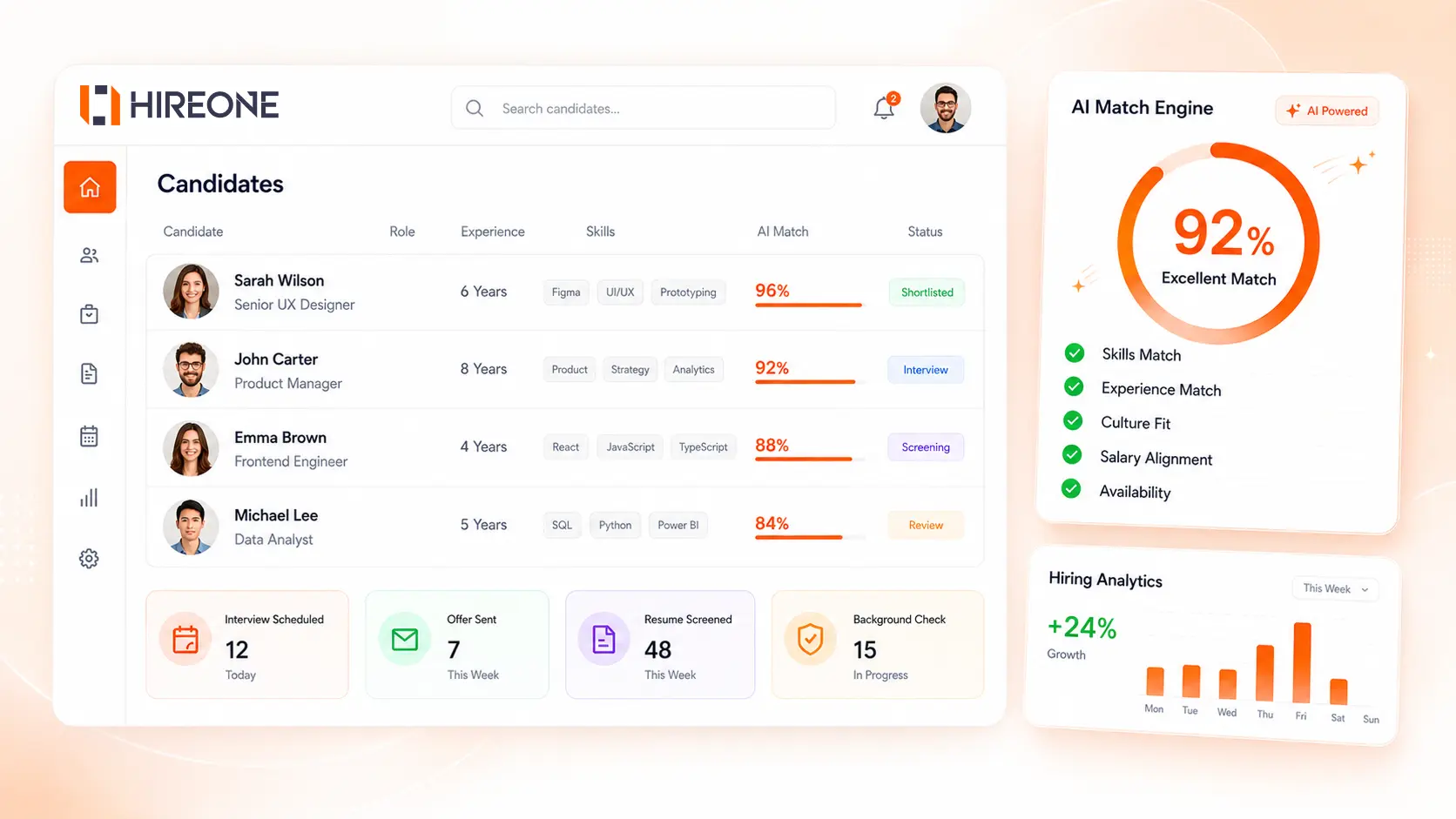
Faster Screening
Review large volumes of applications without hours of manual work.
Better Matching
Identify candidates whose skills and experience align with the role.
Smarter Decisions
Use consistent evaluation criteria and recruitment insights.
Table of Contents
The New Reality of Recruitment
Recruitment teams are expected to fill positions faster, evaluate growing numbers of applications and create a positive candidate experience—all while managing multiple vacancies and coordinating with hiring managers.
Traditional recruitment processes depend heavily on manual resume reviews, keyword searches, spreadsheets, disconnected tools and repetitive administrative tasks. As hiring demands increase, these processes become slower and harder to manage.
AI hiring platforms provide recruitment teams with a more scalable approach. They automate time-consuming activities, improve candidate matching and provide better visibility throughout the hiring process.
KEY INSIGHT : AI does not remove the recruiter from hiring. It gives recruiters more time to focus on candidates, interviews and important hiring decisions.
Why Traditional Recruitment Is Becoming Harder
Manual and fragmented recruitment processes create delays for recruiters, hiring managers and candidates.
Too Many Applications
Popular job postings can attract hundreds or thousands of applications, making manual resume review slow and difficult.
Time-Consuming Screening
Recruiters often spend hours reviewing resumes before they can begin speaking with qualified candidates.
Delayed Shortlisting
Slow screening processes postpone interviews and increase the risk of losing strong candidates to faster-moving employers.
Inconsistent Evaluation
Different recruiters may interpret candidate qualifications differently, resulting in inconsistent shortlisting.
Administrative Overload
Interview scheduling, candidate updates, workflow management and internal coordination consume valuable recruiter time.
Limited Hiring Visibility
Disconnected recruitment data makes it difficult to understand pipeline performance, identify delays and improve hiring outcomes.
Why Recruiters Are Adopting AI Hiring Platforms
Recruiters are adopting AI because it helps them manage repetitive and high-volume recruitment tasks more efficiently while keeping people involved in important decisions.
Faster Resume Screening
AI can analyse large numbers of applications and prioritise candidates whose qualifications align with the job requirements. This helps recruiters reach suitable applicants faster without reviewing every resume manually.
Better Candidate Matching
Traditional screening often depends on exact keyword matches. AI can evaluate a wider combination of information, including skills, work experience, qualifications, job requirements, role relevance and candidate suitability. This provides recruiters with a more complete view of each applicant.
More Consistent Shortlisting
AI applies predefined evaluation criteria across applications. This helps recruitment teams create a more structured and consistent initial screening process.
Reduced Administrative Work
Recruitment automation can support repetitive activities such as resume screening, applicant ranking, interview scheduling, candidate pipeline updates, recruitment workflow management and hiring reports.
Improved Candidate Experience
Faster screening, organised scheduling and timely communication help candidates move through the recruitment process with fewer delays.
Scalable Recruitment
AI hiring platforms allow recruiters to manage increasing application volumes and multiple job openings without proportionally increasing their manual workload.
Data-Driven Hiring Decisions
Recruitment analytics help hiring teams understand pipeline performance, identify process delays and continuously improve their recruitment strategies.
Manual Recruitment vs AI-Powered Recruitment
| Hiring activity | Manual recruitment | AI-powered recruitment |
| Resume screening | Recruiters review resumes individually | AI analyses and prioritises relevant applications |
| Candidate matching | Based largely on keywords and manual judgement | Evaluates skills, experience and job requirements |
| Applicant ranking | Candidates are compared manually | Applicants are ranked using defined criteria |
| Interview scheduling | Requires repeated emails and coordination | Scheduling workflows can be automated |
| Candidate evaluation | May vary between recruiters | Applies more consistent screening criteria |
| Hiring visibility | Information may remain across disconnected systems | Recruitment data is available from one platform |
| Recruitment scaling | Requires additional time and recruiter effort | Supports higher hiring volumes more efficiently |
| Recruiter focus | Administrative and repetitive activities | Candidate engagement and strategic decisions |
How AI Improves Recruiter Productivity
Recruiter productivity is not simply about processing more applications. It is about giving recruiters more time for work that requires human judgement, communication and relationship-building.
With repetitive tasks supported by AI, recruiters can spend more time on:
- Speaking with qualified candidates
- Conducting meaningful interviews
- Collaborating with hiring managers
- Evaluating communication and interpersonal skills
- Understanding candidate expectations
- Strengthening employer branding
- Developing better recruitment strategies
- Making final hiring decisions
HIGHLIGHT STATEMENT : Let AI handle recruitment busywork so recruiters can focus on building stronger teams.
AI Resume Screening and Candidate Matching
Traditional resume screening often relies on manual review and simple keyword searches. This can cause relevant candidates to be overlooked when their resumes use different terms or formats.
AI resume screening evaluates candidate information against the requirements of a role. It can help prioritise applicants whose skills, experience and qualifications are relevant to the position.
Candidate matching takes this process further by comparing multiple data points rather than relying on a single keyword.
This helps recruiters:
- Find qualified candidates faster
- Reduce manual review time
- Improve shortlisting consistency
- Focus interviews on relevant applicants
- Manage high application volumes
- Make more informed screening decisions
Does AI Replace Recruiters?
No—AI supports recruiters.
AI hiring platforms are designed to assist recruitment teams, not replace human expertise.
AI Is Effective For Screening resumes; matching candidates; ranking applicants; scheduling interviews; managing repetitive workflows; organising recruitment data; producing hiring insights. | Recruiters Remain Essential For Building candidate relationships; conducting interviews; evaluating communication skills; understanding motivation; assessing team compatibility; negotiating offers; managing sensitive conversations; making final decisions. |
KEY MESSAGE : The future of recruitment combines AI efficiency with recruiter expertise.
When Should Recruiters Start Using AI?
An organisation should consider an AI hiring platform when recruitment challenges begin affecting hiring speed, consistency or candidate experience.
READINESS CHECKLIST
Your organisation may be ready for an AI hiring platform if:
- Recruiters receive more applications than they can review efficiently
- Manual resume screening consumes too much time
- Qualified candidates are not shortlisted quickly enough
- Interview scheduling regularly causes delays
- Candidate communication is inconsistent
- Shortlisting criteria vary between recruiters
- Recruitment data is spread across multiple tools
- Hiring teams lack visibility into candidate pipelines
- The organisation is hiring for several roles simultaneously
- Recruitment demand is increasing without additional resources
If several of these situations apply, AI can help make the recruitment process more manageable and scalable.
When Should Recruiters Start Using AI?
HireOne.ai combines AI-powered recruitment capabilities with organised, recruiter-friendly workflows.
The platform helps hiring teams move from application review to shortlisting with greater speed, structure and visibility.
Resume Screening Analyse applications and identify candidates who align with the role. | Intelligent Candidate Matching Compare candidate skills, experience and qualifications with job requirements. |
Applicant Ranking Prioritise applicants based on their relevance to the position. | AI Phone Screening Conduct structured initial screening and collect relevant candidate responses. |
Interview Scheduling Reduce delays caused by manual scheduling and repeated coordination. | Candidate Pipeline Management Track candidates throughout different stages of the recruitment process. |
Recruitment Automation Reduce repetitive administrative work and keep hiring workflows moving. | Hiring Insights Gain better visibility into recruitment activity and make more informed decisions. |
FAQs
What is an AI hiring platform?
An AI hiring platform uses artificial intelligence to support and automate recruitment activities such as resume screening, candidate matching, applicant ranking, interview scheduling and workflow management.
Why are recruiters using AI hiring platforms?
Recruiters use AI hiring platforms to reduce manual work, process applications faster, improve candidate matching and make recruitment workflows more consistent.
How does AI resume screening work?
AI resume screening analyses candidate information against job requirements and helps recruiters prioritise applicants whose qualifications are relevant to the role.
Does AI replace recruiters?
No. AI supports recruiters by handling repetitive activities. Recruiters remain responsible for interviews, relationship-building, candidate evaluation, offer discussions and final hiring decisions.
Can AI improve candidate experience?
AI can support a better candidate experience by reducing screening delays, accelerating scheduling and helping recruitment teams maintain a more organised process.
What should businesses look for in an AI hiring platform?
Businesses should evaluate candidate screening, matching, ranking, scheduling, workflow automation, analytics, usability, data security and integration capabilities.
When should a company adopt an AI hiring platform?
Companies should consider adopting AI when application volumes, manual workloads, scheduling delays or inconsistent processes begin affecting recruitment performance.
See HIREONE.AI in Action
Build a faster, more organised recruitment process with AI-powered screening, matching and workflow automation.
- Automate resume screening
- Find relevant candidates faster
- Improve pipeline visibility
- Spend more time engaging candidates
- No credit card required.
Hire Smarter. Move Faster. Build Better Teams.
Bring resume screening, candidate matching, applicant ranking and recruitment workflows together with HireOne.ai.
Related Blogs
Why Recruiters Are Adopting AI Hiring Platforms
Discover why recruiters are adopting AI hiring platforms to automate...
Read More